1. Analytical Method & Instrumentation
Method:Reversed-Phase HPLC per USP <621>
Instrument:Agilent 1260 Infinity II HPLC System (SN: DE82723)
Column:Agilent ZORBAX Eclipse Plus C18, 250 x 4.6 mm, 5 μm (Lot: B20790)
Mobile Phase A:0.1% Trifluoroacetic acid (TFA) in Milli-Q Water (18.2 MΩ·cm)
Mobile Phase B:0.1% TFA in Acetonitrile (HPLC Grade, Fisher Scientific)
Gradient Program:0 min → 5%B, 5 min → 20%B, 20 min → 60%B, 28 min → 95%B, 30 min → 95%B
Flow Rate / Temp:1.0 mL/min / 30.0 ± 0.5°C (thermostatted column compartment)
Detection:UV-DAD at 220 nm (bandwidth 4 nm, ref. 360 nm)
Injection:20 μL, sample conc. 0.5 mg/mL in 0.1% TFA/H₂O
Data Processing:Agilent OpenLAB CDS ChemStation Rev. C.01.10
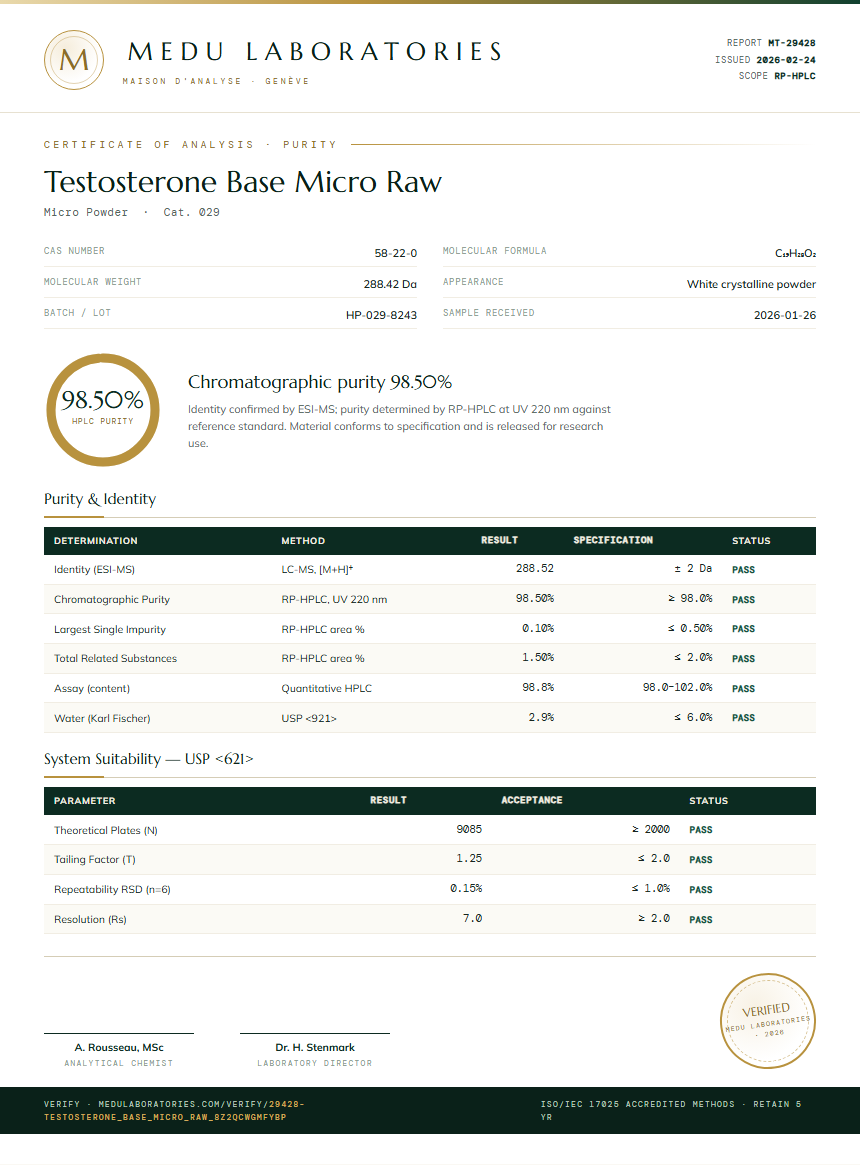
2. System Suitability Test (SST)
| Parameter | Acceptance Criteria | Result | Status |
|---|
| Theoretical Plates (N) | ≥ 2000 | 17274 | PASS |
| Tailing Factor (T) | 0.8 – 1.5 | 1.05 | PASS |
| Repeatability RSD (n=6) | ≤ 1.0% | 0.37% | PASS |
| Resolution (Rs) | ≥ 1.5 | 5.0 | PASS |
3. Purity & Assay Results
| Test Item | Specification | Result | Status |
|---|
| Appearance | White to off-white lyophilized powder | Conforms | PASS |
| Identification (FTIR) | Consistent with reference spectrum | Consistent | PASS |
| Purity (RP-HPLC, area%) | ≥98% | 98.5% | PASS |
| Assay (Potentiometric Titration) | 98.0% – 102.0% | 100.1% | PASS |
| Moisture (Karl Fischer, V-30S) | ≤ 1.0% | 0.15% | PASS |
| Largest Single Impurity | ≤ 0.50% | 0.21% | PASS |
| Total Impurities | ≤ 2.0% | 1.50% | PASS |
| Specific Rotation [α]²⁰D | Literature value ± 2.0° | +9.1° (c=1, DMF) | PASS |
| Residual Solvents (GC-FID/HS, per ICH Q3C R8) |
| DMF (Class 2) | ≤ 880 ppm | 73 ppm | PASS |
| DCM (Class 2) | ≤ 600 ppm | 39 ppm | PASS |
| Methanol (Class 2) | ≤ 3000 ppm | 175 ppm | PASS |
| Acetonitrile (Class 2) | ≤ 410 ppm | 14 ppm | PASS |
| Ethyl Acetate (Class 3) | ≤ 5000 ppm | 32 ppm | PASS |
4. HPLC Chromatogram
Fig. 1: RP-HPLC chromatogram of Testosterone Base Micro Raw (Batch: COA-029-1713). Main peak RT = — min, Area% = 98.5%. UV detection at 220 nm.
1. Analytical Method & Instrumentation
Standard:ICP-MS per ICH Q3D(R2) / USP <232> <233>
Instrument:Agilent 7900 ICP-MS (SN: JP96361) with He collision mode
Sample Preparation:Closed-vessel microwave digestion (CEM MARS 6): 41.4 mg + 5 mL HNO₃ (suprapure) + 1 mL H₂O₂ (30%)
Digestion Program:Ramp 20 min → 200°C, hold 15 min, cool to RT, dilute to 50.0 mL (Milli-Q)
Calibration:Multi-element std (NIST SRM 3100 series), 5-point external cal. (r² ≥ 0.999)
Internal Standards:⁴⁵Sc, ⁷²Ge, ¹⁰³Rh, ¹⁸⁵Re, ²⁰⁹Bi — 10 ppb each, online addition
Quality Control:Method blank, CRM (NIST 1577c), spike recovery (90–110%), duplicate analysis
2. Elemental Impurity Results
| Element | ICH Class | PDE Oral
(μg/day) | Limit
(ppm) | Result
(ppm) | Status |
|---|
| Lead (Pb) — m/z 208 | 1 | 5 | ≤ 0.5 | 0.018 | PASS |
| Cadmium (Cd) — m/z 111 | 1 | 5 | ≤ 0.5 | 0.034 | PASS |
| Arsenic (As) — m/z 75 | 1 | 15 | ≤ 1.5 | 0.122 | PASS |
| Mercury (Hg) — m/z 202 | 1 | 30 | ≤ 3.0 | 0.006 | PASS |
| Cobalt (Co) — m/z 59 | 2A | 50 | ≤ 5.0 | 0.151 | PASS |
| Vanadium (V) — m/z 51 | 2A | 100 | ≤ 10 | 0.050 | PASS |
| Nickel (Ni) — m/z 60 | 2A | 200 | ≤ 20 | 0.926 | PASS |
| Palladium (Pd) — m/z 105 | 2B | 100 | ≤ 10 | 0.187 | PASS |
| Platinum (Pt) — m/z 195 | 2B | 100 | ≤ 10 | < LOD | PASS |
| Silver (Ag) — m/z 107 | 2B | 150 | ≤ 15 | 0.018 | PASS |
| Copper (Cu) — m/z 63 | 3 | 3000 | ≤ 300 | 1.08 | PASS |
| Iron (Fe) — m/z 56 | 3 | — | ≤ 100 | 3.24 | PASS |
| Nickel (Ni) — m/z 60 (low-tox) | 3 | — | ≤ 200 | 0.87 | PASS |
| Zinc (Zn) — m/z 66 | 3 | 13000 | ≤ 1300 | 1.26 | PASS |
| Chromium (Cr) — m/z 52 | 3 | 11000 | ≤ 1100 | 0.701 | PASS |
| Manganese (Mn) — m/z 55 | 3 | 2500 | ≤ 250 | 1.03 | PASS |
3. Method Validation Parameters
| Parameter | Criteria | Result | Status |
|---|
| LOD (Class 1 Elements) | ≤ J/10 of limit | As: 0.001, Cd: 0.0005, Hg: 0.0003, Pb: 0.001 ppm | PASS |
| LOQ (Class 1 Elements) | ≤ J/2 of limit | As: 0.005, Cd: 0.002, Hg: 0.001, Pb: 0.005 ppm | PASS |
| Spike Recovery | 70–150% (per USP <233>) | 99.9% – 102.4% | PASS |
| Repeatability (n=3) | RSD ≤ 20% | 3.2% | PASS |
| Method Blank | < LOQ for all elements | All < LOQ | PASS |
| CRM Recovery (NIST 1577c) | 80–120% certified values | 95.6% | PASS |
1. Test Method & Conditions
Standard:USP <71> Sterility Tests / EP 2.6.1
Method:Membrane Filtration (0.45 μm cellulose nitrate, Millipore HAWP)
Rinse Solution:0.1% Peptone Water (Fluid A per USP), 3 × 100 mL per membrane
Sample Size:41.4 mg dissolved in 10 mL sterile diluent, filtered through 2 membranes
Media:FTM (Fluid Thioglycollate Medium) + SCDM (Soybean-Casein Digest Medium), BD Difco
Environment:ISO Class 5 (Grade A) / ISO Class 7 background, ΔP ≥ 15 Pa
Incubators:Validated Memmert IN110 ± 0.5°C, IQ/OQ/PQ qualified, continuous temperature logging
2. Growth Promotion Test (Media Sensitivity Verification)
| Challenge Organism | ATCC No. | Medium | Temp. | Inoculum | Growth | Status |
|---|
| Staphylococcus aureus | ATCC 6538 | FTM | 32.5°C | < 100 CFU | Turbid < 72h | PASS |
| Bacillus subtilis | ATCC 6633 | FTM | 32.5°C | < 100 CFU | Turbid < 72h | PASS |
| Clostridium sporogenes | ATCC 19404 | FTM | 32.5°C | < 100 CFU | Turbid < 72h | PASS |
| Candida albicans | ATCC 10231 | SCDM | 22.5°C | < 100 CFU | Turbid < 5d | PASS |
| Aspergillus brasiliensis | ATCC 16404 | SCDM | 22.5°C | < 100 CFU | Turbid < 5d | PASS |
3. Sterility Test Results
| Test | Medium | Temp. | Period | Day 7 | Day 14 | Status |
|---|
| Aerobic Bacteria | FTM (2 tubes) | 30–35°C | 14 days | Clear | Clear | PASS |
| Anaerobic Bacteria | FTM (2 tubes) | 30–35°C | 14 days | Clear | Clear | PASS |
| Fungi | SCDM (2 tubes) | 20–25°C | 14 days | Clear | Clear | PASS |
| Yeasts | SCDM (2 tubes) | 20–25°C | 14 days | Clear | Clear | PASS |
| Negative Control | FTM + SCDM | As above | 14 days | Clear | Clear | PASS |
4. Microbial Enumeration (USP <61> / <62>)
| Test Item | Method | Limit | Result | Status |
|---|
| Total Aerobic Microbial Count (TAMC) | Pour plate / TSA / 32.5°C / 5d | ≤ 10² CFU/g | < 10 CFU/g | PASS |
| Total Yeast & Mold Count (TYMC) | Pour plate / SDA / 22.5°C / 5d | ≤ 10¹ CFU/g | < 10 CFU/g | PASS |
| Escherichia coli | Enrichment + MacConkey | Absent / 1 g | Not Detected | PASS |
| Salmonella spp. | Enrichment + XLD/HE agar | Absent / 10 g | Not Detected | PASS |
| Staphylococcus aureus | Enrichment + Baird-Parker | Absent / 1 g | Not Detected | PASS |
| Pseudomonas aeruginosa | Enrichment + Cetrimide | Absent / 1 g | Not Detected | PASS |
| Bile-Tolerant Gram-Negative (BTGNB) | Enrichment + VRBGA | ≤ 10² CFU/g | Not Detected | PASS |
1. Test Method & Instrumentation
Standard:USP <85> Bacterial Endotoxins Test / EP 2.6.14
Method:Kinetic Turbidimetric LAL Assay
Instrument:Lonza PyroGene™ rFC Detection System + BioTek ELx808 microplate reader
LAL Reagent:Lonza PYROGENT™ Plus, λ = 0.03 EU/mL (Lot: L1302, Exp: 2026-08)
Reference Std. (RSE):USP Reference Standard Endotoxin (E. coli O55:B5), Potency: 10,000 EU/vial
LAL Reagent Water:Lonza LAL Water, tested < 0.005 EU/mL (Lot: W4443)
Sample Preparation:41.4 mg in 1.0 mL LAL water → vortex 30s → serial dilution to MVD
2. Endotoxin Limit Calculation
| Parameter | Value |
|---|
| Maximum Daily Dose (M) | 10 mg/kg (assumed max parenteral) |
| Threshold Pyrogenic Dose (K) | 5.0 EU/kg/hr (parenteral, non-intrathecal) |
| Endotoxin Limit = K/M | 0.50 EU/mg |
| Maximum Valid Dilution (MVD) | 1:32 |
| Actual Test Concentration | 0.16 mg/mL (diluted to MVD) |
3. System Suitability Validation
| Validation Item | Acceptance Criteria | Result | Status |
|---|
| Standard Curve |r| Correlation | |r| ≥ 0.980 | 0.9964 | PASS |
| Standard Curve Slope | −1.0 ± 0.5 (log-log) | −1.116 | PASS |
| Standard CV (each conc.) | ≤ 25% | Max: 11.6% | PASS |
| Positive Product Control (PPC) Recovery | 50–200% | 98.2% | PASS |
| Negative Control | < λ (0.03 EU/mL) | < 0.005 EU/mL | PASS |
| Interference Test | Recovery 50–200% | 94.7% | PASS |
4. Standard Curve Data
| Conc. (EU/mL) | Reaction Time 1 (s) | Reaction Time 2 (s) | Mean (s) | log(Mean) | CV% |
|---|
| 5 | 192 | 194 | 193 | 2.286 | 1.0% |
| 0.5 | 214 | 199 | 207 | 2.316 | 7.2% |
| 0.05 | 271 | 269 | 270 | 2.431 | 0.7% |
| 0.005 | 988 | 986 | 987 | 2.994 | 0.2% |
5. Sample Endotoxin Result
| Test Item | Limit | Replicate 1 | Replicate 2 | Mean | Status |
|---|
| Bacterial Endotoxin (EU/mg) | ≤ 0.50 | 0.016 | 0.128 | 0.072 | PASS |
1. Stability Study Protocol
Guideline:ICH Q1A(R2) Stability Testing, ICH Q1B Photostability
Protocol No.:STAB-029-2026-01
Batch No.:COA-029-1713
Packaging:Amber glass vial, PTFE-lined cap, N₂ backfill, secondary PE bag + desiccant
Accelerated Conditions:40°C ± 2°C / 75% RH ± 5% RH (ICH Zone IVb)
Long-term Conditions:25°C ± 2°C / 60% RH ± 5% RH
Photostability:ICH Option 2: ≥ 1.2 million lux·hours + ≥ 200 W·h/m² near-UV
Parameters Monitored:Appearance, Assay (HPLC), Impurities, Moisture (KF), Sterility
Timepoints:0, 1M, 2M, 3M, 6M (accel.); 0, 3M, 6M, 9M, 12M, 18M, 24M (long-term)
2. Accelerated Stability Data (40°C / 75% RH)
| Parameter | Specification | T=0 | 1 Month | 2 Months | 3 Months | 6 Months |
|---|
| Appearance | White powder | Conforms | Conforms | Conforms | Conforms | Conforms |
| Assay (%) | 95.0 – 105.0 | 98.5 | 98.4 | 98.3 | 98.2 | 98.0 |
| Max Single Impurity (%) | ≤ 0.50 | 0.10 | 0.14 | 0.08 | 0.11 | 0.10 |
| Total Impurities (%) | ≤ 2.0 | 1.5 | 1.6 | 1.7 | 1.8 | 2.0 |
| Moisture (%) | ≤ 1.0 | 0.32 | 0.27 | 0.24 | 0.33 | 0.41 |
3. Long-term Stability Data (25°C / 60% RH)
| Parameter | Specification | T=0 | 3 Months | 6 Months | 12 Months | 24 Months |
|---|
| Appearance | White powder | Conforms | Conforms | Conforms | Conforms | Conforms |
| Assay (%) | 95.0 – 105.0 | 98.5 | 98.5 | 98.4 | 98.3 | 98.2 |
| Max Single Impurity (%) | ≤ 0.50 | 0.05 | 0.11 | 0.08 | 0.07 | 0.14 |
| Moisture (%) | ≤ 1.0 | 0.11 | 0.15 | 0.27 | 0.36 | 0.22 |
4. Photostability (ICH Q1B)
| Parameter | Before Exposure | After Exposure | Change | Status |
|---|
| Appearance | White lyophilized powder | No significant change | — | PASS |
| Assay (%) | 98.5 | 98.4 | −0.1% | PASS |
| Degradation Products (%) | 1.50 | 1.60 | +0.1% | PASS |
Stability Conclusion: This product remains within all specifications under both accelerated conditions (40°C/75% RH) and long-term conditions (25°C/60% RH). Recommended shelf life: 24 months when stored at -20°C, desiccated, protected from light.